
Why You Can’t Find Loads?
One of the most common reasons users fail to find loads is that their search criteria is too narrow. By setting filters that are too specific—such as exact pickup times, locations, or rates—you limit your results to loads that rarely appear on the Amazon Relay Load Board.
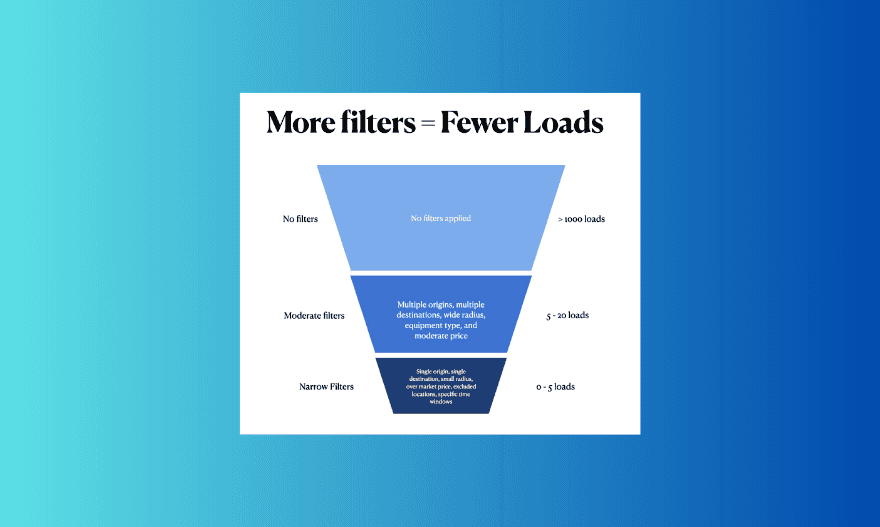
Even though loads vary daily, many Amazon Relay users stick to specific routes or loads they want to target without exploring other opportunities. This narrow focus is often familiarity or habit, but it can limit success.

Rather than adapting their strategy, many users repeatedly run the same searches with very high price-per-mile expectations—exactly the types of loads that attract the most competition. Instead of widening their scope to explore less competitive routes or adjusting their criteria, it’s easier to blame the lack of loads in the market. By failing to look at the broader market, they miss valuable opportunities that could improve their overall profitability.
How to fix this:
1️⃣ Start by broadening your search filters to increase the range of loads you’re targeting. Avoid over-filtering, which limits your load options.
2️⃣ To do that, use automation tools and their features such as single notification or non-stop load search to analyze the load board activity and verify whether the loads you’re searching for even exist.
3️⃣ Monitor patterns in load availability and adjust your criteria accordingly.
Why People Lose Loads?
Even when loads are visible, they’re often lost because of intense competition. High-demand loads, like short, high-paying trips, attract a lot of carriers who are all competing for the same opportunity. These loads disappear in milliseconds, so fast that regular users won’t even see them on Amazon Relay with the naked eye.

Another critical factor is the market itself. In some regions, the number of loads available on Amazon Relay is inherently limited. No matter how optimized your setup is, there may simply not be enough loads to meet the demand. Understanding your market’s limitations can help you set realistic expectations and adjust your strategy accordingly. Sometimes, the number of loads on Amazon Relay is genuinely limited in certain regions. But before you adjust your strategy, make sure that’s really the case. To understand your market, you need to analyze load availability. Use tools to count how many loads appear over time. Our article explains how we can help you track these patterns. Only after proper analysis can you be confident there are no loads in your area—and that you’re not just missing them because they’re getting grabbed too quickly.

How to improve your chances:
1️⃣ Invest in More Server Power: Faster speed translates to a higher success rate for securing loads. Adding more server power increases your ability to refresh faster and reduces your chances of missing loads. To clarify, this isn’t about setting the refresh speed to the maximum on a single computer. In fact, pushing a single machine to its limits can lead to diminishing returns due to technical constraints and Amazon Relay's speed thresholds. (I have talked about it in this video). Most likely, the capabilities of a Google Chrome extension alone won’t be enough for high-demand scenarios. To truly improve your chances, you’ll need to switch to Riley, our web-based application designed to handle multiple servers to enhance speed and reliability, giving you a significant advantage over competitors using standard extensions.
2️⃣ Target Less Competitive Loads: Most people lack the patience, work ethic, or time to think strategically about their trips. Instead of analyzing how to secure a return route or sitting at their computers to find these opportunities, they take the easy route—chasing the highest-paying, short trips. This is why these loads will always be the most competitive. To gain an edge, think of ways to find less competitive loads that offer the potential for return trips. Many of these loads are overlooked, even though they can lead to more consistent profits in the long run. In some cases, you can even book these loads manually after finding them with notification features. By diversifying your approach and targeting loads that others ignore, you can maximize profitability without overextending your resources.
What is the right load booking automation strategy based on your fleet size?
Should Amazon Relay load booking be fully automated or partly manual? The answer largely depends on your company’s resources and strategy.
For smaller companies, such as one-truck operations, automating everything makes sense. If you don’t have the time to sit and book loads manually, automation can handle it efficiently enough, and since you only need a limited number of loads, full automation is likely sufficient for your needs.
On the other hand, fully manual load booking is a more expensive approach. This method often involves hiring dispatchers or spending your own time managing bookings. While this makes sense on certain load boards where automation isn’t possible, it’s not the most efficient approach for Amazon Relay.
We recommend adopting a hybrid approach when working on Amazon Relay, especially if you have resources like dedicated dispatchers. With this strategy, you can automate some of your bookings using Autobooking for highly competitive loads while simultaneously targeting less competitive loads manually through Notification Features, Post a Truck or Contracts.
This hybrid setup allows you to:
1️⃣ Compete for High-Demand Loads: Let automation handle the competitive loads to maximize your chances.
2️⃣ Target Less Competitive Loads Manually: Use notification features to find overlooked opportunities and build profitable round trips.
Take Advantage of Missed Opportunities
Many automation users make the mistake of not running their software consistently. By limiting their searches to regular business hours or targeting only specific loads, they miss out on countless opportunities that arise during off-hours. I’ve personally witnessed people not using the tools they’ve set up—even when it only takes pressing one button! Consistency is key, and I can guarantee that sticking to a routine will bring you the results you’re looking for. By running your software regularly, you’ll position yourself ahead of 90% of users who lack the discipline to do so.
How to capture more loads:
Leave the software running 24/7, including at night and on weekends. This increases your chances of booking loads that others miss simply because they’re not active. You’ll be surprised at how many loads you can secure while you’re sleeping or spending time with friends.

Consistency isn’t just a strategy—it’s a competitive advantage. Use automation to secure loads for the following day or week. Planning ahead reduces last-minute stress and helps avoid missed opportunities.