Introduction:
If you've ever streamed a movie or played an online game, you've probably experienced network latency at some point. Network latency refers to the delay that occurs when data is transmitted from one device to another over a network, such as the internet.

Contrary to popular belief, network latency is not caused only by your computer or your home wifi. Rather, it's a result of the physical distance between the two devices communicating, the number of hops the data needs to make, and the quality and capacity of the network infrastructure in between.
Imagine you're trying to have a conversation with someone on the other side of the world using a satellite phone (just an example 😅). When you speak, your voice is transmitted as radio waves up to the satellite orbiting the Earth, then back down to your conversation partner's phone. However, since the signal has to travel such a long distance, there will be a delay between when you speak and when the other person hears you. This delay is called network latency and can make the conversation feel unnatural or disjointed.
Similarly, when you're using an online service like Amazon Relay, data has to travel back and forth between your device and Amazon's servers. The more distance the data has to travel, the more latency there will be. This can impact the performance of the service, such as delays in receiving real-time updates and most importantly your booking time. By understanding the role of network latency in this process, we can work to optimize the service and minimize delays and increase the speed of booking on the Amazon Relay load board.
Competitive Advantage:
Now that we understand what network latency is and how it relates to Amazon Relay, let's take a closer look at why lower latency can provide a competitive advantage for users.
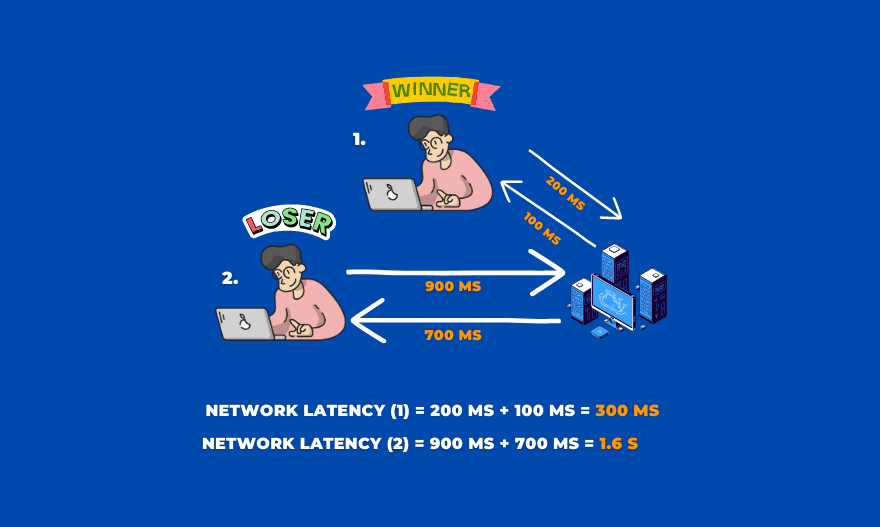
Firstly, lower latency means faster communication and quicker response times. When data is transmitted more quickly, users can receive real-time updates and respond to changes more efficiently. For example, if a load appears on the load board, users with lower latency will see the load first and have more time to adjust.
Secondly, lower latency can help users stay ahead of their competition. In the fast-paced world of logistics and supply chain management, every millisecond counts. By leveraging the speed and efficiency of Amazon Relay, users can gain an edge over their competitors and capture more business.
Overall, network latency may seem like a technical concept, but its impact on the performance of services like Amazon Relay cannot be overstated. By reducing latency and improving communication, users stay competitive in a rapidly changing marketplace.
There are several ways that Amazon Relay users can reduce network latency and improve the performance of the service. Here are a few examples:
1️⃣ Use a high-speed, reliable internet connection: The quality and speed of the user's internet connection can have a significant impact on network latency. Using a high-speed, reliable connection can help minimize latency and provide a smoother user experience.
2️⃣ Minimize the number of devices on the network: The more devices that are connected to the network, the more data that is being transmitted, which can increase latency. To minimize latency, users can try to limit the number of devices that are connected to the network while using Amazon Relay.
3️⃣ Use a wired connection instead of Wi-Fi: While Wi-Fi is convenient, it can be less reliable than a wired connection, particularly if there are multiple devices using the same Wi-Fi network. Using a wired connection can help reduce latency and provide a more stable connection.
These are the several steps that Amazon Relay users can take to minimize network latency. But what if I told you we can take this a little bit further?
From the information above, you’ve probably figured out that our goal as a user is to reduce the time data has to travel from us (the user) ➡️ Amazon. The most efficient way to do that is to host your application on an AWS server that is located in a data center close to where Amazon Relay processes information. By doing so, the distance between the user's application and the Amazon Relay servers is minimized, which can reduce latency and improve the performance of the service dramatically.
What is AWS?
AWS stands for Amazon Web Services, and it is a cloud computing platform provided by Amazon. Cloud computing is a way to deliver computing resources, such as servers, storage, and databases, over the internet on a pay-as-you-go basis. In other words, instead of hosting and managing your own physical servers, you can use AWS to access computing resources that are hosted in Amazon's data centers around the world.
By using AWS, businesses can quickly scale their IT infrastructure up or down as needed, without the need to invest in expensive hardware or worry about managing their own data centers. Yes, AWS is still a paid service 😅, but many logistics businesses find that the return on investment is well worth the cost.
If you're interested in learning more about AWS and the various services it offers, the best place to start is the official AWS website. Here, you'll find a wealth of information about the platform, including detailed documentation, case studies, and white-papers that can help you understand the benefits and capabilities of AWS.
The AWS website also offers a range of resources to help you get started with the platform, including tutorials, videos, and training courses that can help you learn how to use the various AWS services. Additionally, the site provides access to a vibrant community of AWS users and experts who can provide support and guidance as you navigate the platform.
Companies taking advantage of non-tech trucking people:
It can be frustrating to hear that some companies are taking advantage of non-tech people by charging high prices for services that could be obtained more affordably through AWS. It's important to do your research and ensure that you're working with a reputable company that has your best interests in mind if you do not want to learn it yourself.

If you're considering purchasing a remote server or other cloud computing service, it's a good idea to compare pricing and features across different providers to ensure that you're getting a fair deal. By doing your due diligence and choosing a provider that meets your needs and budget, you can ensure that you're getting the most value for your investment and avoid falling prey to unscrupulous companies that may be trying to take advantage of your lack of technical expertise. You can always contact us if you need any assistance.
Conclusion:
By understanding how network latency works and taking steps to minimize it, users can gain a competitive advantage in the fast-paced world of Amazon Relay. One way to reduce network latency is by using AWS, a cloud computing platform provided by Amazon that allows businesses to quickly scale their IT infrastructure up or down without investing in expensive hardware or worrying about managing their own data centers. Companies that take advantage of non-tech people by charging high prices for services that could be obtained more affordably through AWS should be avoided. By taking these steps, businesses can improve the performance of their logistics processes on Amazon Relay and stay ahead of the competition.